
An AI employee is an AI system you train once on how you do one specific job, and that then does the job the way you would, every time, on a schedule, without a new prompt. It's different from a chatbot the same way an employee is different from a gumball machine. You hire an employee, you train them, and they do the work whether you're at your desk or at your kid's soccer game.
We run our whole company this way, and most founders who tell me they "use AI" have never built one. Founders in our programs report getting 15 to 20 hours a week back once AI employees are running. That's what the gap costs.
The gumball machine and the factory
Most people use AI like a gumball machine. Put in a quarter, get one gumball, start over. The quarter is your prompt: you type out what you need, you get one output, and tomorrow you're back at zero with a blank box and a blinking cursor. Nothing you taught it yesterday survives to today.
An AI employee is the factory. You build it once and it makes gumballs all day, and you stop being the one standing there feeding in quarters. Trained on your voice, your process, and your standards, it handles the job while you do something better with your brain.
A prompt gets you 40% there, and an AI employee crushes it the way you would, every single time. That 60% gap is the difference between AI that impresses you for a weekend and AI that runs a department.
Most people who say they use AI are offloaders
I hear this from founders every week: "I tried AI but it just gives me generic stuff that doesn't sound like me."
That founder is an offloader. She opens a chat window, hands the AI a task cold, takes whatever comes back, and spends twenty minutes fixing it. The AI has never seen her voice, her clients, or her standards. She got a stranger's work back, because the AI is a stranger. She never trained it.
Offloading isn't a technology problem, and switching from ChatGPT to Claude won't fix it. Nothing was ever taught, so nothing was ever learned. A tool without a workflow is just another tab you forget to close.
The founders getting real leverage from AI made one shift. They stopped treating AI like a search engine and started treating it like a new hire. You'd never hand a new employee one task with zero context and then complain that the work doesn't sound like you. Training is the job. Within 24 months there will be two types of leaders, the ones who think WITH AI and the ones who think ABOUT AI, and the training is what separates them.
The difference between AI tools and AI employees, part by part
Every AI employee we build has three parts.
Instructions.
The role and the rules, written the way you'd brief a new hire. Who it is, what job it owns, where the lines are.
A knowledge base.
Your SOPs, your brand voice, your real client questions, and examples of what perfect output looks like. This is the part that makes it yours instead of generic.
Training that sticks.
You correct it once and it stays corrected, which is the piece the chat window never gave you.
AI employees grow through four levels: a saved skill you reuse, a skill trained inside a Claude Project with its own knowledge base, an employee connected to your tools like Notion or your CRM, and an employee running on a schedule that does its job without you starting it. That last level is where "AI employee" stops being a metaphor, because the work happens while you sleep.
How to build your first one this week
You don't need a developer. This is not a techie skill set, it's resourcefulness, and if you're a good communicator you're going to be great at this.
Pick one job you've done a hundred times.
Not your hardest task, your most repeated one: the weekly report, the client follow-up email, the proposal. If you could do it half asleep, it's trainable.
Gather ten examples of your best work on that task.
This is training data and you already own it.
Open a Claude Project and write instructions like an onboarding doc.
Who it is, what the job is, and how you decide what good looks like. Load your examples in.
Train it the stubborn way.
Run the task. Correct what's wrong, specifically. "No, that's wrong. This is how I do it. This is how I make this decision." Run it again. My dad did this for about twenty hours on his first one, manually then AI, manually then AI, and he's 65 and calls me when his email breaks.
Put it on a schedule.
Once you trust the output, stop being the one who starts it. The job should happen because it's Tuesday, not because you remembered.
The first one is the slowest. Every one after gets faster, because training is the skill that compounds.
My Fridays used to take 3 hours
Every Friday I used to spend 3 hours trying to write my newsletter, and by hour two I still didn't know what to say. So we built one AI employee that mines every transcript in my business, finds the gold, and drafts the newsletter in my voice. Twenty minutes and it's done, and that's not counting the carousels and ads it also preps before 9 AM.
3 hrs → 20 min
Callan's Friday newsletter, one AI employee
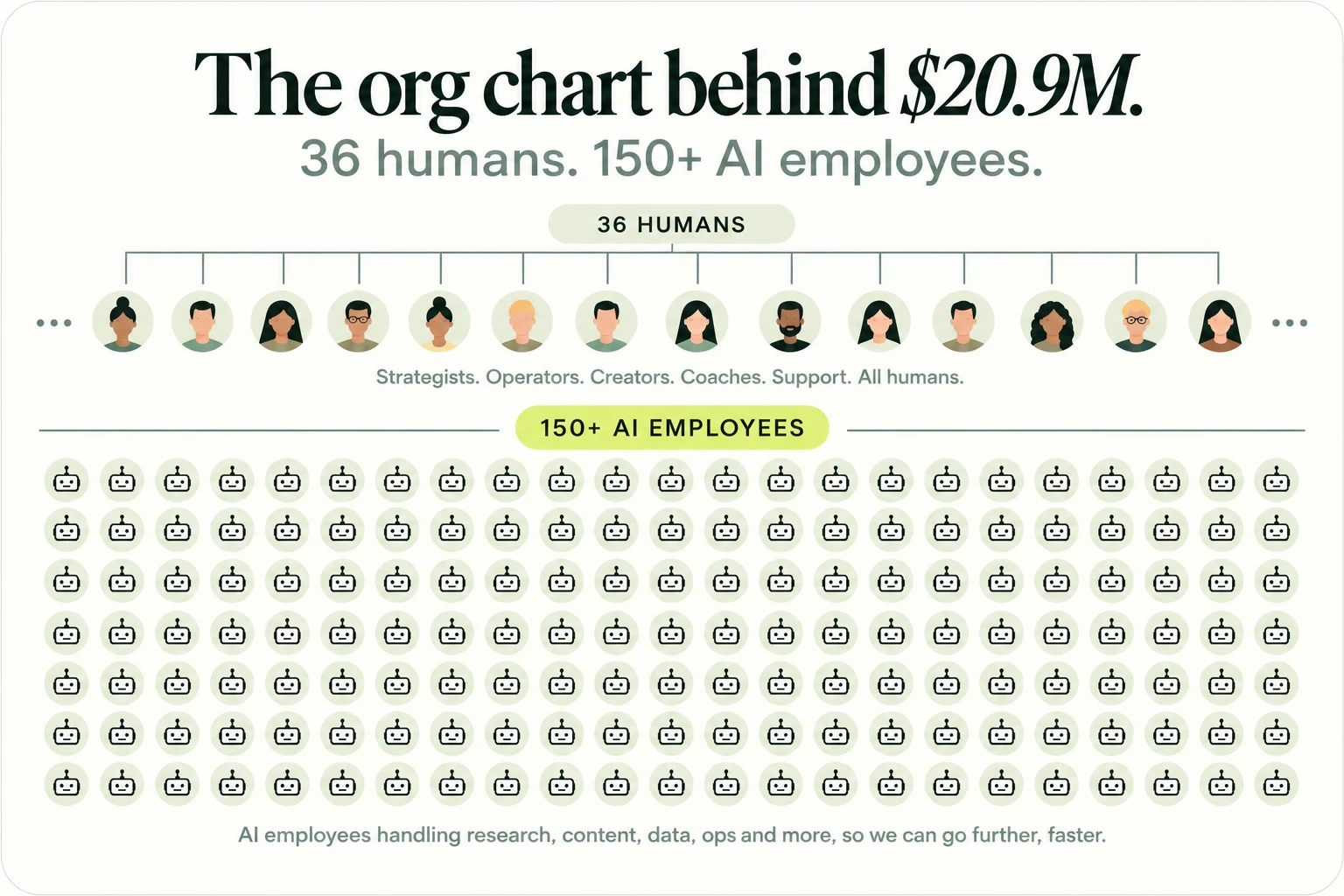
That's one AI employee. We did a $20.9M launch with only 36 humans and over 150 AI employees, and I don't share that to impress you. I share it because the role of the human has changed. The human's job is no longer to do the work, it's to build the AI employees that do the work.
Kaelyn Sitar runs Blue Lime Property Maintenance. She dropped her meeting transcripts into an AI employee and got back 30 SOPs, perfectly formatted, about 2 minutes each. Documenting those processes by hand was going to be a 50-hour project she was never going to start. That's not "using AI," that's an AI employee.
Every Friday I write The Uncommon Business Weekly from inside an 8-figure company growing to 9 figures: what we're building, how we think, and the founder story as it happens. Join 100,000+ founders and leaders. It takes under 3 minutes to read, and it's always free.
Join the free Friday newsletter
Questions founders ask me about AI employees
What is the difference between AI tools and AI employees?
An AI tool waits for you. You bring the prompt and the context every time, and it hands back one output. An AI employee is trained once on your voice, your process, and examples of your best work, then does the whole job your way on repeat. The tool is the gumball machine. The employee is the factory.
What are some examples of AI employees?
A newsletter writer trained on every transcript in your business. An SOP builder that turns meeting recordings into documented processes. A proposal drafter loaded with your pricing logic and your won deals. One job each, trained deep, running on a schedule.
What is the difference between AI agents and AI employees?
"AI agent" is the tech industry's word for software that can take actions on its own. An AI employee is an agent plus the part most people skip: training on your business, your voice, and your judgment, managed like a member of your team. Plenty of businesses have agents nobody trained, and they're the reason so much AI output sounds like nobody wrote it.
One email every Friday, from inside the build.