
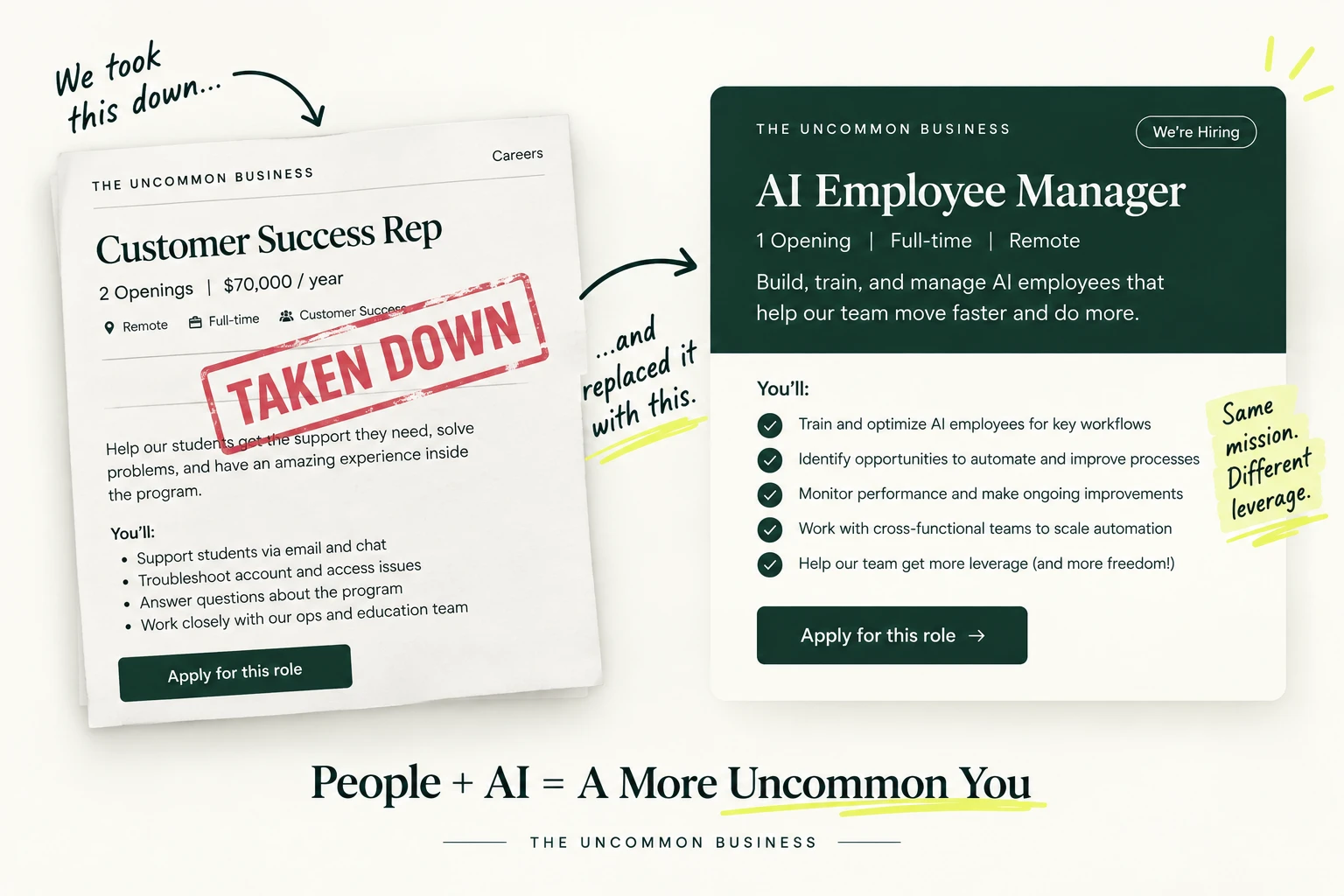
If the role you are about to post is pattern recognition on work your business has done a thousand times, do not hire for it yet. Train an AI employee on the pattern first, then hire the human to manage what you built. The math is lopsided: about $9K one time trains five or more AI employees, while a single human hire runs $6K a month, every month. We faced this exact decision at The Uncommon Business with a $70K customer success posting, and we took the posting down.
What went up in its place is the part the AI doom headlines get wrong.
The inbox is compounding, your team is maxed, and the instinct that carried you to $3M kicks in: post the job. Before it goes up, run the test we use.
The job-description test: when to automate instead of hire
Every role at our company runs through one filter first. We call it the job-description test. Print the posting and read it line by line, marking every responsibility as pattern or judgment.
Pattern is work your business has done so many times the answers already exist. Answering the same customer questions. Formatting the weekly report. Sending the follow-up nobody enjoys writing. Judgment is work with real stakes and no template, like reading an upset client and knowing this one needs a phone call.
If most of the page is pattern, the role fails the test. You are about to pay salary, benefits, onboarding, and training for work your business already knows how to do. The knowledge is sitting in your sent folder, your Slack history, and your team's heads. Train it into an AI employee first, and save the hiring budget for judgment. Start with what an AI employee is if the term is new.
We have AI draft a response to every single email that comes in from a client, because all it is is pattern recognition. The answers we had typed hundreds of times were training data we were paying humans to retype.
Decisions like this one fill my Friday newsletter: the behind-the-scenes of growing an 8-figure company to 9 figures, what we're building, how we think, and the real math.
Join the free Friday newsletter
We took down the $70K posting and put up a different one
The hire-or-AI question usually gets framed as founders swapping people for software. That is not what happened here, and it is not what I teach.
We had a customer success posting up for two spots, $70K a year each, plus benefits, onboarding, and training. Emails and Slack messages were coming in from everywhere. Then my director of operations came to me and said, "I just connected Claude Code to our email and our Slack channels, and I pulled out the top 300 questions our customers have ever asked us. I trained an AI employee on every single one of those questions and answers, and then I taught it to write in your voice. I reverse engineered the last 100 emails you sent to write like you, think like you, and talk like you."
So we took the posting down. And we put up a different one: one person, not two, hired to manage the AI employees. We stopped hiring hands and started building the line.
That is the new role. The job did not disappear, it moved up a level, from typing the answers to running the system that drafts them.
Hiring another pair of hands vs. building the line
Here's the way I think about it. Every business starts out as a room full of people making things by hand, and the founder is usually the fastest pair of hands in the room. So when the work piles up, the obvious move is to add another pair of hands, and that instinct is the one that got you to where you are.
Building the factory is a different decision. You stop asking who can do this job and you start asking what it would take to build the thing that does this job. It's slower on day one and it's a completely different business by month six.
That's what the job-description test is sorting for. Pattern work is the work a line can run, and every time you train an AI employee on it you have added a line to the factory, one that keeps running whether you show up on Tuesday or not. Judgment work stays with people, because it always should.
And a factory still needs humans, just not the ones standing at the machines. It needs the people who build the lines, watch the output, and catch it early when something starts drifting. That is the role we posted instead of the two we took down, and it's the role I'd hire for in your business too.
Founders at your level tell me "I just need to hire better people," and your people were never the problem. You could hire five more and still be the constraint. The test changes what the humans on your org chart get paid to do, not how many of them there are.
How to run the test this week
Run the test first. Thirty minutes, a printout, a pen. Mark every line pattern or judgment and count. If you are hiring because you are drowning, read how to stop being the bottleneck in your business first. The posting is usually a symptom.
Then pull the training data you already own. Ours was the top 300 customer questions, pulled by connecting Claude Code to email and Slack. Yours might live in your sent folder, your proposals, or your intake calls. Train the voice too, because untrained AI sounds generic no matter how good the answers are. We reverse engineered my last 100 sent emails so the drafts sound like me and not like a bot.
Then run it in shadow mode. Every incoming email gets an AI draft and a one-minute human review before anything sends. We ran ours through a three-hour training session with the team, and we now answer emails ten times faster with a tenth of the energy. Nothing goes out untouched.
The posting that survives is the judgment lines from your printout, plus a new line at the top: manages and improves our AI employees.
The cost comparison nobody runs: keeping the human you already have
Rebecca Stone is an affair recovery coach who went through Automate to Accelerate last fall, and her version of this decision is my favorite, because no posting came down. A long-term team member was ready to leave, not over the work, but because Rebecca had no model that kept her in a leadership seat and still made enough revenue. Rebecca took the problem to her money coach, an AI employee trained on her numbers, and worked out a restructure that kept her. Her words: "The money coach alone has saved me $20,000 because I was able to figure out how to keep a long-term team member who was ready to leave."
She built two years of systems in three months, and the win she named first was a person who stayed.
The hiring question and the keeping question are the same question. Move the pattern work into trained systems, and the money and the people go where the judgment lives. Jennifer Coleman ran the math, $9K one time against $6K a month for a hire, and it paid for itself in month one.
$9K once vs. $6K every month
training five or more AI employees vs. one human hire
Run the test before you post the job. And every Friday I write the rest of it: the behind-the-scenes of growing an 8-figure company to 9 figures, what we're building, and how we think. Join 100,000+ founders and leaders. It takes under 3 minutes to read, and it's always free.
Join the free Friday newsletter
What founders ask before making this call
What does AI cost compared to hiring an employee?
About $9K one time to train five or more AI employees, against roughly $6K a month for one human hire. The AI employee doesn't resign, and the training compounds into the next one you build.
When should I automate instead of hire?
Automate when the role is pattern recognition on work your business has done a thousand times: repeat questions, recurring reports, follow-ups. Hire when the role needs judgment, relationships, or someone to manage the systems. The job-description test sorts the two in thirty minutes.
Will AI replace my existing team?
Not if you run it the way we do. AI employees take the repetitive work so your humans move up to managing systems and making the calls that need a human. We took down a $70K posting and created a new human role in the same move.
One email every Friday, from inside the build.