
To stop being the bottleneck in your business, stop routing every decision through a human brain, including yours. Map one workflow, mark every spot where work waits on you, and train an AI employee to run those exact spots. The move is called Workflow Audit → AI Injection, and it is how CEO Kimberly Rommen took back 500+ hours in six months. Most founders try to fix this by hiring instead, and that is exactly why it stays broken.
Why your business can't run without you
You built this business by being excellent at everything, the proposals sounded right because you wrote them, and the clients stayed because you answered them. Somewhere past a few million in revenue, that excellence turned into a line outside your office. Every approval, every edge case, every judgment call stands in it and waits.
I hear the same sentences from founders at this stage. I'm making every decision and I can't step away. My team is great but they can't think strategically without me. I haven't taken a real vacation in two years. Those are not delegation failures. That is a business where the judgment lives in one brain, and the brain is yours, running at 90 to 95 percent capacity with nothing left for the thinking that grows the company.
The fix, the way I taught it in February
On our SuperHuman masterclass this February I put it in one line. Think critically about your ACTUAL workflow first. Then ask where AI fits.
Most founders run that order backwards, they sprinkle AI on everything, get generic output, and go back to doing the work themselves. The framework is called Workflow Audit → AI Injection, and it moves in three steps.
Map the workflow. Not the version in the SOP nobody reads. The real one, where the proposal sits in your inbox for two days because only you know how to price it.
Find the friction points. A friction point is anywhere work stops and waits on a specific human. In a founder-run business, most of them are you.
Inject AI at those points. Not everywhere, just where the waiting happens. You train an AI employee on that exact moment and the line outside your office gets shorter by one.
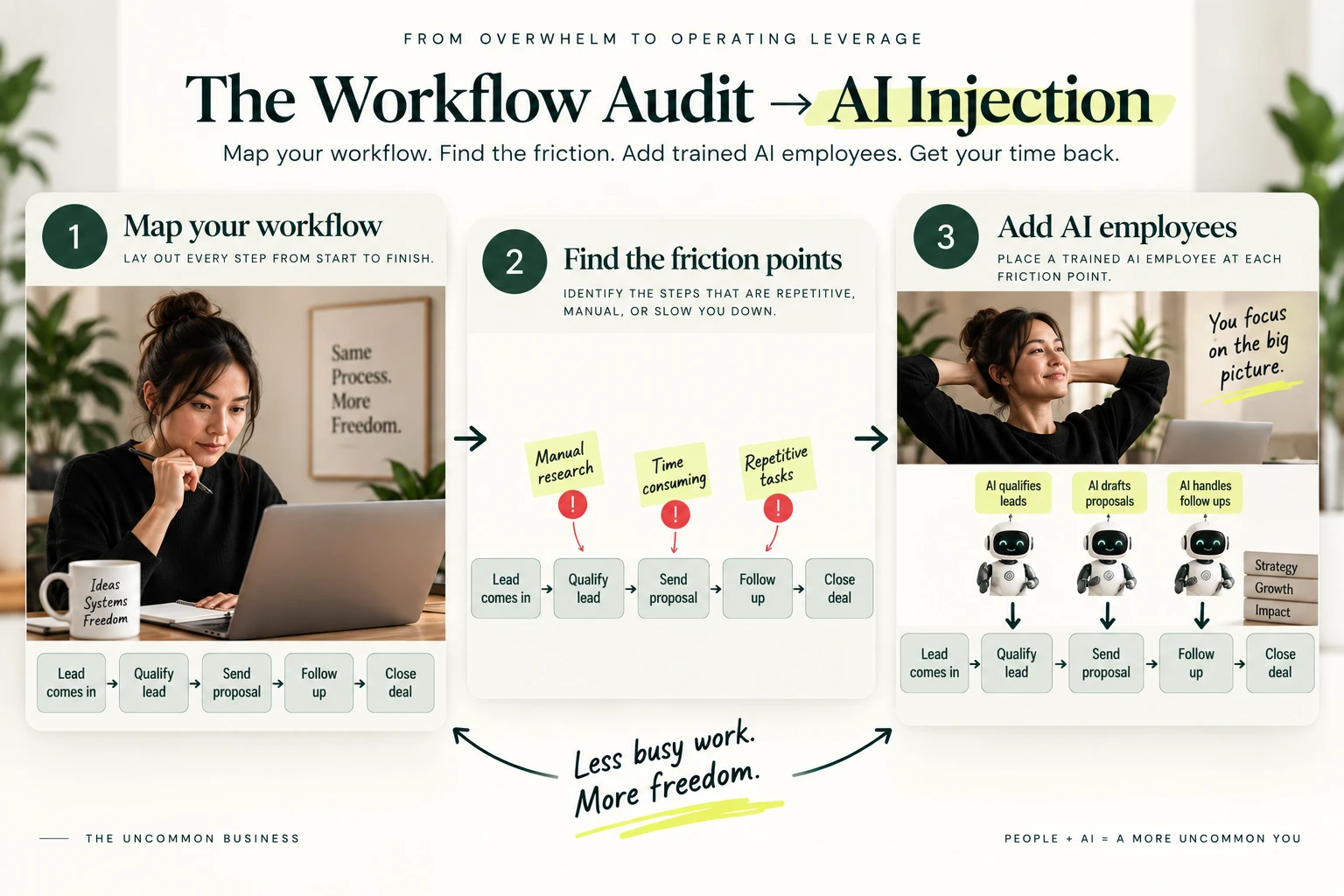
The most basic thing we believe at The Uncommon Business: the least valuable thing a human can do is repetitive work, and the most valuable thing a human can do is think. Every friction point you hand to an AI employee moves you from implementation back to imagination, the layer your business has been missing.
Hiring more people will not fix this
The load is too heavy, so your head goes straight to adding a person. But every delegation path to another human also costs your time. You interview, onboard, train, review, and answer questions, and six months in the important decisions still route through you, because the judgment never left your head. It just got a longer commute.
Your team is not the problem. Your systems are. You teach an AI employee how you decide once, and it holds that judgment at 2pm and at 2am, on the day you are at your kid's recital. If you are weighing a specific role, should you hire another employee or use AI, which walks through the math.
Do this before Friday
The audit needs one afternoon, not a retreat or a consultant.
Pick the workflow you dread most. The weekly report, client onboarding, proposals.
Talk it out. Narrate every step into a voice memo like you are training a new hire, ten minutes, no polish. That transcript is your map.
Mark where work waits on you. Your answer, your review, your rewrite.
Sort each one into two piles. Pattern recognition or true judgment. You have priced that proposal a thousand times, and all it is is pattern recognition.
Train one AI employee on one pile. Open a Claude project, write custom instructions covering the role, how you decide, and where you draw the line, and load your last 50 real examples as its knowledge base. Then correct it every time it misses. Live builds with us take 20 to 25 instruction revisions before the output holds up. That is not failure, that is the training.
One workflow, one friction point, one AI employee. You can make that move this week.
Join the free Friday newsletter
What the other side looks like
Kimberly Rommen is the CEO of American Training Center, and she was the bottleneck her whole company waited on. She spent six months building AI employees into her own workload and saved 500+ hours. Then she showed her team one example, a single Brand Guardian, and within a month they had adopted Claude across the business on their own. She went from bottleneck to the person her team copies. A different job, and a much better one.
500+ hours
saved by CEO Kimberly Rommen in her first 6 months
She has company. Perrie Finsand got 20+ hours a week back and was elected Vice President of the Routt County Humane Society board during the 12-week program. Ulka Wilson kept revenue flat, doubled her profits, and sleeps 3 to 4 extra hours a night. And Siri Amrit Khalsa said the sentence I think about most: "My normal day now equals what used to be my absolute best day from 18 months ago."
Not one of those results came from a new hire.
The bottleneck was one chapter for us. Every Friday I write the behind-the-scenes of growing an 8-figure company to 9 figures: what we're building, how we think, and what I'd do differently. Join 100,000+ founders and leaders. It takes under 3 minutes to read, and it's always free.
Join the free Friday newsletter
Questions founders ask me next
Why can't my business run without me?
Because the judgment lives in your head instead of in your systems. Your team can execute, but any decision that needs your thinking waits for you. Move that thinking into AI employees, and the business keeps moving whether you are in the room or not. Start with what an AI employee is.
How do I fix founder decision fatigue?
Reduce the decisions that reach you instead of hunting for more energy. Run the workflow audit, sort what reaches you into pattern recognition and true judgment, and train AI employees on the first pile. Participants across our masterclasses report 15 to 20 hours a week back, and the mental quiet matters more than the hours.
Will hiring more people fix the bottleneck?
No, because hiring adds capacity for doing, and doing was never your constraint. Deciding was. Until the way you decide is trained into systems, every new person adds more questions that route back to you. Fix the layer first, then hire humans to manage what you built.
One email every Friday, from inside the build.