
AI gives you generic answers because it has nothing of yours to work with. That's as true in Claude, where we run our whole company, as it is in ChatGPT. The AI has never seen your voice, your data, or the thousand judgment calls you make without thinking, so it fills the gap with the average of the internet. The fix is training, which means teaching the AI how you do the work until it does the work your way. My dad did it at 65, with one AI employee and about 20 hours of training, and it earns him $8,000 a month.
Most founders never get there, because they keep trying to fix a training problem with better prompts.
I hear the same sentence from founders doing $3M to $10M every week: "I tried AI but it just gives me generic stuff that doesn't sound like me." So she goes back to writing the proposals herself, because at her level generic is worse than nothing. She is doing the only thing anyone ever showed her, typing a request into a chat box and hoping. A better prompt gets you a better average. The missing piece is context, the stuff only you know.
Spot, Build, Train
Everything we teach at The Uncommon Business runs on one skill set: Spot, Build, Train. You spot the task that deserves an AI employee, the one you repeat a thousand times a year. You build the AI employee, the instructions, the examples, and the knowledge it works from. Then you train it, correcting it against your own work until your standards live inside the system.
Spotting takes an afternoon. Building takes a day or two. Training is where the real time and judgment go, and it is the step almost everyone skips, which is why their output sounds like it came from the same machine. It did.
The training is what separates an AI employee from a chatbot you prompt all day — read what an AI employee is if that term is new. An AI employee gets trained once, then does the job the way you would, every time. Developing the full skill set takes 40 to 60 hours. I know how that number lands when your calendar is already full, and my dad, who calls me when his email stops working, got a sellable product out of 20 of them.
You cannot hire the training out
The instinct at this level is to delegate it. You have the money, not the time, and there is no shortage of consultants who would love the project.
One of our students, an expert in organic viral marketing, did exactly that. She had a full-time AI guy on payroll, and he built beautiful agents, the kind of build that demos well in a Monday meeting. Then she tested the output, and it was terrible. Her voice, her genius, and her context were never baked in, because he did not have them. Nobody but her does.
Hiring a headhunter does not mean your new Director shows up trained. Same with AI. The training is the job, and no consultant knows your voice, your data, or where you draw the line.
He trained it the stubborn way
My dad is 65. He is a manufacturer's rep from Minnesota who spent 40 years selling kitchen gadgets to Target, and he is so nontechnical that sharing his screen on Zoom is still a full family event.
He has also been building data reports from Target for FORTY years. Every Friday someone at his company pulls raw data from the Target portal, formats it by hand, calculates sell-through rates, and sends out the report. Tedious hours that only make sense to someone who knows which numbers matter. Then at breakfast with a friend in the industry he said "what if I built an AI employee, like my daughter Callan has, to just do this for us?"
He spent about 20 hours training it, and the man was STUBBORN. Claude kept getting calculations wrong and formatting things in ways that did not match how he does it, and he just kept correcting it. No. That's wrong. Nope. This is how I do it. This is how I make this decision. Over and over and over.
He did not trust it, so he ran the report manually, then through the AI employee, and compared the two. Manually, then AI. Manually, then AI. Until it caught on.
Now his AI employee turns raw Target data into interactive dashboards with inventory alerts and recommended actions based on his knowledge. He signed his first client at $8,000 a month, and he is in conversations with other manufacturer reps to sell it for $10,000. Everyone obsesses over the tools and the prompts, but the value of an AI employee lives in the TRAINING, and that training comes from the human.
20 hours to $8,000 a month
Callan's dad trained one AI employee on 40 years of expertise
My own voice skill took me 12 to 16 hours over 12 months, and I am still correcting it weekly.
The fastest way to feel the difference is to hand AI some real context and watch what changes. I put the 3 prompts I use every day into one free guide.
How to train AI to write in your voice
You can run the Spot, Build, Train loop on one task this week.
Spot one task. Pick the one you could grade in your sleep. Client emails, proposals, your weekly report. One task, not ten.
Build the container. Open a Claude Project, a workspace that remembers everything you feed it, and load it with real examples. Your last 20 proposals. The 10 emails that sound most like you. If you have been living in ChatGPT for a year, export that history, because your ChatGPT history is training data.
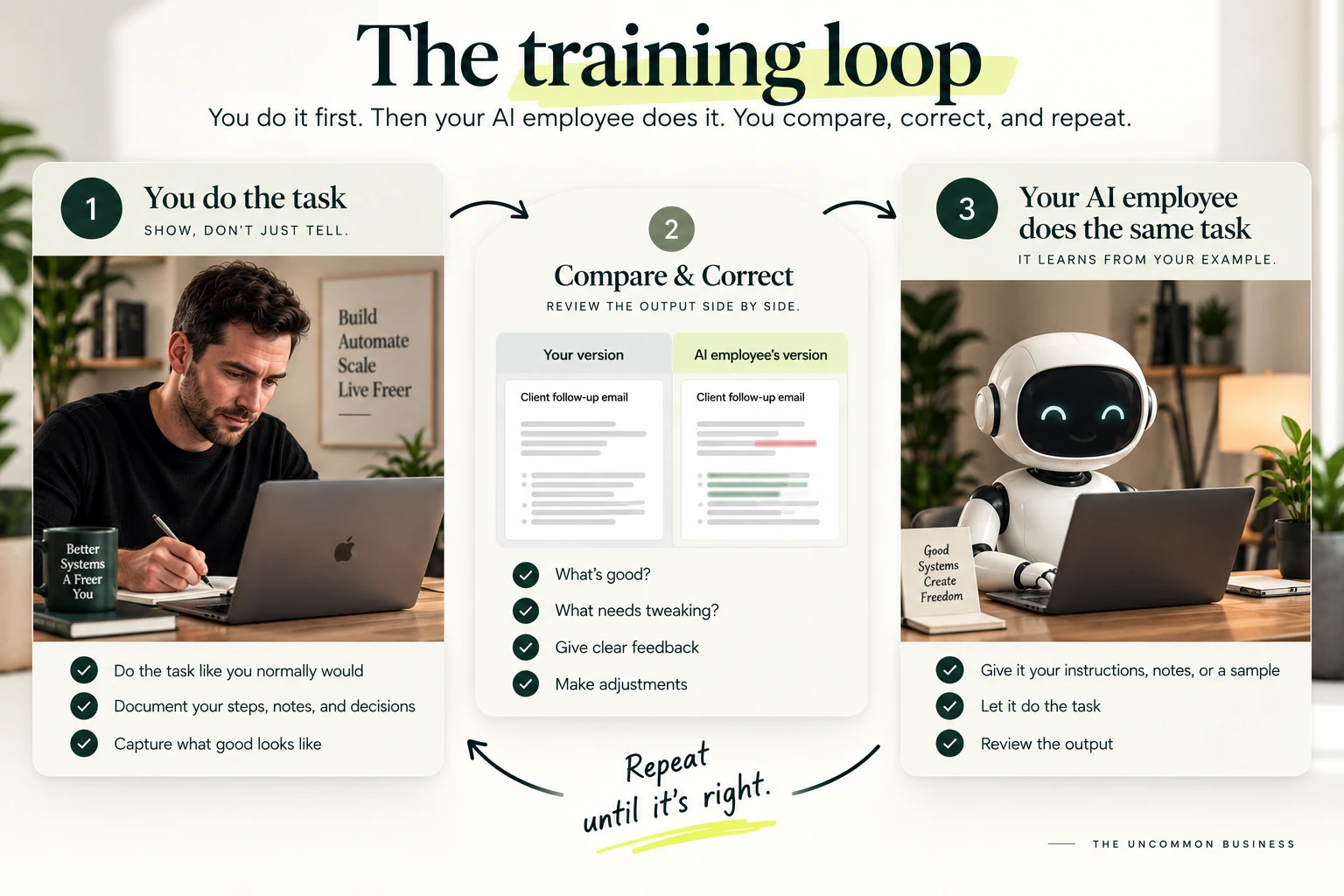
Train it against yourself. Do the task manually one more time, have the AI do it, and put the two side by side. Then correct it in plain words, the way you would correct a sharp new hire. "This is too formal." "We never promise dates." "I would open with the number." And tell it how you want the reader to FEEL, because emotional direction changes the output more than any prompt hack I have found.
Stay skeptical until it earns you. AI will absolutely lie to you, so check its math against your own version every round. My dad ran his loop across weeks of Saturday mornings. When the output passes your hardest test without a correction, you have an AI employee, and generic becomes someone else's problem.
The questions founders ask next
How do I train AI to write in my voice?
Feed it 10 to 20 real examples of your writing inside one project, then correct its drafts side by side against something you wrote yourself until the gap closes. The examples teach it your patterns, and the corrections teach it your standards. Expect hours spread over weeks, not minutes.
Why does AI content sound robotic?
Untrained AI writes the average of everything it has read, and the average has no point of view. Output turns robotic when the AI knows nothing about your reader, your voice, or the outcome you want. Give it those three things and the same model writes like a person.
Can I pay someone to train AI for me?
You can hire out the build, the setup and the wiring. You can't hire out the training, because training is your expertise, your voice, and your judgment moving into the system, and no outside expert has those. That transfer is what makes the output yours instead of everyone's.
Three prompts, free, and they work from the first message.