
The fastest way to write client proposals is to stop writing them from scratch. You train an AI system once on three things you already have, your won proposals, your pricing logic, and your objection answers, and from then on it drafts while you review. Founders who build this cut proposal time from 6 to 8 hours to about 30 minutes, and the proposals come out better. And the hours are not even the real prize.
Siri Amrit Khalsa spent 15 years as a CFO before he built one, and he was losing clients while his proposals sat half-finished for weeks. The build is below, and so is the math, because the number still stops me.
6 to 8 hours to 30 minutes
Siri Amrit Khalsa's proposal time after training his AI on his own frameworks
Train it once on how you sell
We call this build a Sales Wizard. It is an AI employee, which means it is trained once on how you do a job and then does that job your way every time, without a new prompt. It is a different animal from a chatbot, and what an AI employee is is its own article.
The training has three inputs, and you already own all three.
Your won proposals. Not all of them. The five that closed. Winners carry how you frame the client's problem, the order you reveal price, the promises you make and the ones you never make.
Your pricing logic. The spreadsheet, or the rules living in your head. Scope like this starts at $15K. We never discount past 10 percent. Rush work costs more. Every rule you write down is a decision the draft gets right without asking you.
Your objection answers. Prospects ask the same five questions on repeat, and your sent folder holds your best answers. Feed those in and the draft handles the objection before it comes up.
Then it drafts, and you review. Never the other way around.
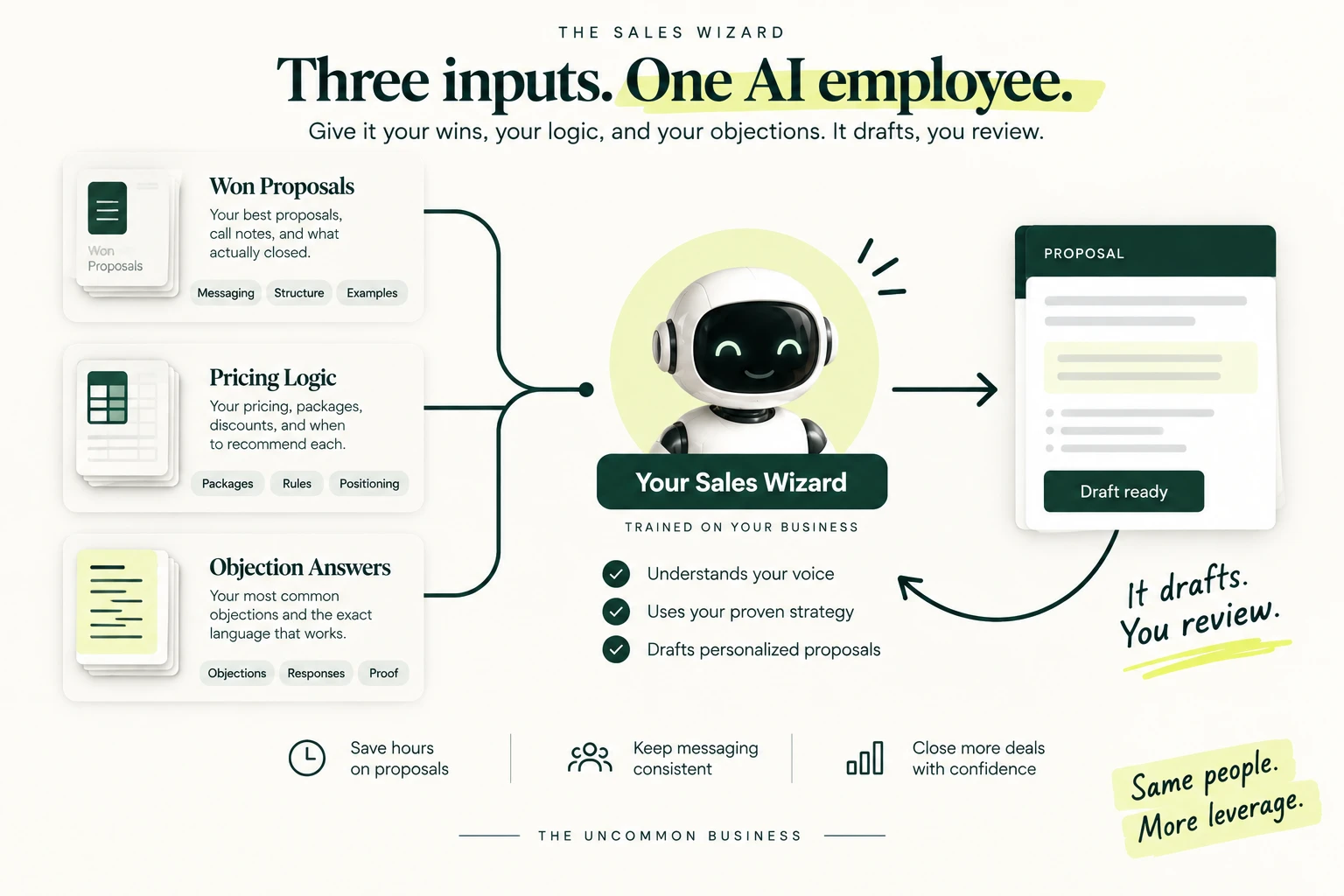
Ours at The Uncommon Business is trained on our sales psychology, books like The Challenger Sale, and 100+ client testimonials. In April it helped us do $1.1M in sales without a sales rep. Same build, bigger knowledge base.
Speed is not the win
Most founders hear "30-minute proposals" and file it under productivity, something for someday. That filing is the expensive part.
Siri was not losing hours. He was losing clients. When a proposal takes 6 to 8 hours, you put it off, and a three-day promise becomes a three-week silence. Buyers ready to move do not wait three weeks. They sign with whoever shows up first with something clear. Speed is not the win. Speed is revenue.
I did this math in a newsletter last spring. Going from 6 to 8 hours to 30 minutes hands a busy consultant 12 to 16 hours back every week, on ONE task. If you bill anywhere from $150 to $500 an hour, that is $1,800 to $8,000 a week in reclaimed value. And if you hired a person to do the drafting instead, that is another $150,000 to $200,000 a year in salary, benefits, and management time.
$1,800 to $8,000 a week reclaimed
12 to 16 hours back at $150 to $500 per hour consulting rates
How to automate your proposals this week
This lives in a Claude Project, a workspace where the AI keeps your files and instructions between conversations.
1. Write the job description. Fill in the custom instructions the way you would onboard a hire: the role, who your clients are, how you sound, where you draw lines.
2. Load the knowledge. Three to five won proposals, your pricing sheet, your objection answers. If the pricing only lives in your head, talk it into a voice tool for ten minutes and upload the transcript. The transcript is the document.
3. Draft a real proposal. Not a test. The one you owe someone right now. Give it your discovery call notes and let it write.
4. Correct it like a new hire. The first draft will get things wrong. Every correction goes into the instructions so the mistake never repeats. Expect 20 to 25 instruction revisions before an AI employee gets it right. That IS the training, and the training is the skill nobody can do for you — the same reason untrained AI sounds generic.
5. Review everything before it goes out. The AI does the drafting. You keep the judgment. That split is the point.
Fifteen years of judgment, baked in
Siri is a single dad in Vancouver who spent 15 years as a CFO, and before he ran his own consultancy he grew his dad's business from $8M to $18M in four years. He knows what good looks like. That was the problem. He calls it trapped genius syndrome. He could walk into any client's business and see everything wrong, and could not scale the delivery of what he saw, because every proposal needed 6 to 8 hours of him. It is the same trap that makes founders the bottleneck in their business — wearing a sales costume.
So he trained an AI sales assistant on his own frameworks, his pricing, his way of thinking through a client's numbers. The drafts come out carrying 15 years of CFO judgment because 15 years of CFO judgment is what went in. His proposals take 30 minutes now, and he says they are twice as good. He sent our team a video with the line I keep quoting: "My normal day now equals what used to be my absolute best day from 18 months ago." This year he is hosting his own masterclasses for CPG founders. The consultant who could not get a proposal out the door now teaches.
He is not the outlier. Kathi Law runs Brook Bay Bookkeeping solo and came into our program drowning daily, her words. Her Sales Wizard drafts proposals and prospect replies that sound like her but, as she puts it, "more put together," and the hours it frees go straight into more prospects. Asked what she would do with 20 extra hours a week, her list included riding her horse. Proposals were standing between a bookkeeper and her horse.
Chad Westbrook, at an engineering firm in St. Paul, talks scope with his team and the client, dictates the rest into the proposal generator he built, and has a finished proposal "in minutes, not hours."
Builds like this one show up in my Friday newsletter, alongside the rest of the behind-the-scenes of growing an 8-figure company to 9 figures: what we're building and how we think about it. Join 100,000+ founders and leaders. It takes under 3 minutes to read, and it's always free.
Join the free Friday newsletter
Questions founders ask about AI for proposal writing
Can AI write client proposals that sound like me?
Yes, if you train it on your material. Untrained AI writes generic proposals because it has never seen your voice, your pricing, or your clients. Train it on your won proposals and correct it for a few weeks and it drafts in your voice. Kathi Law describes her Sales Wizard's output as sounding like her, just "more put together."
How do I automate proposals for a consulting business?
Build one AI employee in a tool like Claude Projects. Feed it your won proposals, pricing logic, and objection answers, then have it draft from your discovery notes while you review every word. Setup takes an afternoon. Expect 20 to 25 corrections in the first few weeks.
Will faster proposals hurt my close rate?
The opposite, in every case above. Siri Amrit Khalsa's proposals dropped from 6 to 8 hours to 30 minutes, twice as good in his words, because the drafting is trained on his winners. And speed itself closes deals.
One email every Friday, from inside the build.